Some things that have caught my eye in the past couple of weeks:
Insect Porn Reveals The Shocking Truth: Spiders Squeak During Sex
The year is barely a month old, but already I may have stumbled across the most bizarre scientific discovery of 2007.
To judge by the truly weird, arachnopornography available at Live Science.Com , female physocylus spiders make a loud squeaking noise during sex. As someone once said, words surpass description.
Seahorses Are Doing It For Themselves
Male seahorses are unique creatures. Not only do they give birth to their young, they also start the whole processs by fertilising themselves. A new study by the Zoological Society of London reveals that their sperm leaves their bodies then re-enters it again via a brood pouch where its eggs then develop. Seriously weird.
Man's Best Friend
The dog really is man's best friend, at least if the latest research is to be believed. Leading canine expert, Deborah Wells of Queen's University, Belfast, claims that people with dogs have lower blood pressure and cholesterol levels than those who don't have a pooch around the house. Dog owners are also healthier than cat owners, Wells claims.
Monday, January 22, 2007


Monday, January 08, 2007
Going The Whole Hog
Thought you might be interested in this piece I wrote for the Family section of last weekend's Guardian. Might explain a little about my strange, possibly unnatural fascination with animals! AB.
I WAS SEVEN when a large sow taught me one of the more valuable, if painful, lessons of my young life: pigs really don't appreciate being ridden, rodeo-style. My moment of enlightenment came one Sunday afternoon, in a muddy pasture on the smallholding where I grew up. Filled with that blend of bravado and brainlessness that only boys of that age possess, I decided to climb on board the fattest of our half dozen or so porkers and "break it in". (I'm fairly certain the idea had been planted by watching a bunch of leathered cowboys taming a steer, earlier that day on Bonanza.)
No sooner had I grasped her leather harness and clambered on board her broad, bristly back, than the sow had shaken off the indolence that had defined her personality since she'd arrived with us and begun performing a passable imitation of a bucking bronco. I held on for all of three seconds before being catapulted, head first, into the mud. The physical bruises faded soon enough; the scars this delivered to my boyhood pride took longer to heal.
Scientists probably don't have catastrophic interactions like this in mind when they talk about the benefits of having animals around. Their arguments tend to focus more on the advantages dogs, cats and hamsters bring in terms of stress-release and proto-parenting, teaching children responsibility and environmental awareness. I have no doubt there is merit in all their assertions. But, it struck me recently, the curious incidents that filled my childhood may offer one or two extra, unheralded arguments in favour of spending our lives close to animals.
When I was 11 or so, for instance, my father and I found a fox cub injured in the woods nearby and brought it home. We nursed it on bottled milk for a few weeks. We converted an old sideboard into his home, even gave him a name, Carlo. No one was more enthusiastic about our new charge than my father, who was fired by memories of his own childhood when he too had reared a stray cub. I remember sensing that our shared responsibility for this poor creature had somehow brought us closer.
One morning I woke up to discover the fox had battered its way through the side of his home and fled. He was gone but he hadn't forgotten. A week later an already more mature-looking Carlo reappeared in a roadside hedge near the entrance to our lane. Rather idiotically, I assumed he'd come back to say thanks. So, unbelievably, did my father. When he kneeled down to stroke the fox, Carlo bit him so hard he almost severed a finger. I'd never seen so much blood. The memory has been locked away ever since, a piece of family lore. Naturally, neither my father nor I has ever trusted a fox since.
In the rural community in which I grew up, animals were part of the daily fabric, especially to my large circle of uncles, many of whom were steeped in the more arcane traditions of country life. One was an accomplished poacher who taught me how to tickle trout. It's a skill I have yet to practice in the Thames tributary that now runs by my home, but you never know when it might come in handy.
Another farming uncle taught me how to spot a sheep that was ready to spontaneously combust. (Hint: if a ewe has been stuck, lying on its side, suffering from "bloat" for several hours and the temperatures are in the 90s, don't light a match anywhere nearby.) Yet another showed me how to read the weather-forecasting skills of cattle and birds. In truth, this was less impressive. It being west Wales, the only weather they tended to predict was rain, which didn't really put them in the Nostradamus class.
The most useless trick a relative passed on to me, undoubtedly, was how to hypnotise a chicken. To my amazement, I saw that by tucking the bird's head under its wings then moving it around slowly in a cyclical fashion, it froze rigid, as if in suspended animation. Unsurprisingly, the beauty of that particular party piece lay in its comedy value. The mere mention of it was enough to reduce the most miserable aunt to laughter. That's another important facet animals bring to family life, of course, as the producers of You've Been Framed have known for decades.
I've spent the bulk of the past 30 years in London, far removed from the rural world in which I was raised. (In reality, it has almost disappeared. Few of the older generation remain and almost all of the old traditions have died away, too.) As a consequence of this, my two young children, Thomas and Gabriella, have missed out on the kind of first-hand animal encounters I took for granted. There have been, of course, memorable moments at zoos and rescue centres, bird parks and nature reserves. Like every other urban family, we've driven round Longleat with baboons attached to the windscreen wipers and wondered at John Aspinall's gorillas at Howlett's in Kent. On holiday in Brazil, we even shared our home with iguanas, macaws and macaque monkeys. The joy these experiences bring the children almost always makes me regret their transience. I feel sad the only foxes they encounter are city scavengers. I often wish they too could do something as daft as learning the art of chicken hypnotism.
This all changed a few months ago, however. It was then that animals - and the simple, sometimes silly pleasures they bestow upon family life - made a small, very small, comeback.
As parents, my wife and I had been resistant to the children's pleas for a cat or dog for a blend of practical and medical reasons. Our home was too confining for a decent-sized dog (and I see no point in having any other). A cat - or any other furry creature - would almost certainly have exacerbated the mild asthma our son, Thomas, occasionally suffered. (Irony of ironies, his first bout was probably triggered by straw mites, encountered during an otherwise brilliant visit to a Devon farm during lambing.) With the latter problem seemingly fading with age, however, our arguments had begun to seem ever more facile.
Then, a year or so ago, I began writing a book on curious animal facts, an assemblage of all the strange things science has taught us about the subjects my country uncles probably knew instinctively. (Cows may not be able to detect rain but, it seems, sharks are capable of detecting bad weather with unerring accuracy.) As talk of how fish communicate by farting (the bright spark that discovered their bubble language named it Fast Repetitive Tick, or FRT) and how mice serenade each other with ultrasonic song flashed across the breakfast table, the children detected the final semblance of their parent's anti-animal resistance melting away. They seized the opportunity with ruthless efficiency. Our home now echoes to the twittering of a four-month-old budgie called Georgie.
Already Georgie is providing the more mundane and obvious benefits those scientists like to talk about. He is a shared responsibility, a warming, unchallenging presence that defuses the stresses of domestic life, a source of entertainment and education. (Did you know budgies are among the most monogamous of all birds? It's partly to do with the fact that females take vicious revenge on a straying male. If he lived in the wild, Georgie would be a hopeless cuckold.)
But he is also beginning to fulfil the role the cows and chickens, foxes and fish played in my country childhood. For a start he generates laughs to rival those produced by talk of hypnotised chickens. You had to be there, of course, but for us the memories of the comic manner in which he fell off his newly installed swing during his first week can produce laughter so violent we fear the children may spontaneously combust.
The little bird's positive influence on the children is already clear. Their Sunday mornings are dedicated to clearing out and cleaning the cage. The budgie's bath times are conducted with diligence and good sense. Pocket money was put aside for a range of Christmas presents for him. He is handled with care and respect. Provided the children keep up their excellent attitude towards the tweating newcomer, other birds - and, who knows, a guinea pig - may follow.
I haven't quite recreated the strange animal-filled landscape of my youth. But I do feel somehow re-connected to the pleasures that a constant, non-human presence can bring. In my more fanciful moments I dream of transforming our home into a place where all manner of animals lie in wait, each of them with a memorable, preferably danger-laced, lesson to deliver Thomas and Gabriella. My wife often accuses me of turning the house into a pigsty. Perhaps we could go the whole hog and stick one or two in the garden.
Monday, December 11, 2006
A Week On The Wild Side, December 10th, 2006
Some things I've noticed in the past week.
The Year's Best Video Nasties
Ever seen an anaconda swallow the world's largest rodent, the south American capybara, or a giant octopus lock tentacles with a shark? Ever witnessed a puffer fish outwit an otter or a black mamba snacking on a squirrel? Didn't think so. Well, feast your eyes on National Geographic's top ten video clips of 2006. Just the thing now that Planet Earth has come to an end on the BBC.
Frosty The Ice Frog
The Australian Sunday Telegraph has been having great fun reporting on how a small frog that had been accidentally turned to ice in a freezer was successfully defrosted, at least for a while. This isn't quite the surprising news it seems. In fact, some types of frog - in common with other species - deliberately place themselves in a state of frozen, suspended animation so as to survive the Winter each year.
The common wood frog, for instance, is able to withstand the Arctic Winter by turning itself into an ice cube. The frog allows two thirds of its body water to freeze, thereby stopping its heart, brain and breathing functions and slowing its metabolism to a crawl. As long as its body temperature doesn’t drop below about 20° Fahrenheit (–6° C) its body will survive on the glucose in its system until the Spring thaw.
Similarly, some breeds of American alligators can survive the winter by freezing their snouts in ice, leaving their nostrils to breath for months on end.
Why Kitty Gets So Forgetful
Scientists at Edinburgh University may have explained why cats get so scatty in their old age. The rather disturbing truth is reported on the New Scientist's excellent daily blog.
All Together Now, Aaaaaaaah
Can't resist cute film footage of pandas? Then here's an early Christmas present, courtesy of Atlanta Zoo and the Associated Press.
The Year's Best Video Nasties
Ever seen an anaconda swallow the world's largest rodent, the south American capybara, or a giant octopus lock tentacles with a shark? Ever witnessed a puffer fish outwit an otter or a black mamba snacking on a squirrel? Didn't think so. Well, feast your eyes on National Geographic's top ten video clips of 2006. Just the thing now that Planet Earth has come to an end on the BBC.
Frosty The Ice Frog
The Australian Sunday Telegraph has been having great fun reporting on how a small frog that had been accidentally turned to ice in a freezer was successfully defrosted, at least for a while. This isn't quite the surprising news it seems. In fact, some types of frog - in common with other species - deliberately place themselves in a state of frozen, suspended animation so as to survive the Winter each year.
The common wood frog, for instance, is able to withstand the Arctic Winter by turning itself into an ice cube. The frog allows two thirds of its body water to freeze, thereby stopping its heart, brain and breathing functions and slowing its metabolism to a crawl. As long as its body temperature doesn’t drop below about 20° Fahrenheit (–6° C) its body will survive on the glucose in its system until the Spring thaw.
Similarly, some breeds of American alligators can survive the winter by freezing their snouts in ice, leaving their nostrils to breath for months on end.
Why Kitty Gets So Forgetful
Scientists at Edinburgh University may have explained why cats get so scatty in their old age. The rather disturbing truth is reported on the New Scientist's excellent daily blog.
All Together Now, Aaaaaaaah
Can't resist cute film footage of pandas? Then here's an early Christmas present, courtesy of Atlanta Zoo and the Associated Press.
Wednesday, December 06, 2006
City birds rap, rural ones sing country.
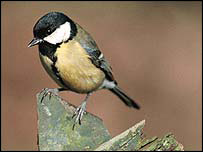
Birds, it seems, have different musical styles that vary according to whether they live in the town or the country. While rural birds like to sing traditional melodies, their urban relatives prefer more modern, rap-style rhythms.
A major study, carried out by a Dutch university and reported here, recorded the singing of great tits in ten major European cities, including London, Paris, Amsterdam and Prague. They then compared their musical efforts with tits living in forests.
While the country birds sang slower, more melodic and “traditional” songs, the study found that urban birds sent out calls that were shorter and faster and were also sung at a higher pitch. The city birds experimented with calls of between one and five notes, while those in forests stuck to the more normal combinations of two, three and four note tunes, the research found.
The authors have concluded the city birds are having to adapt to compete with background noise of the city in order to attract mates.
"Our data show that the adjustment of individual great tits to local noise conditions is not a local phenomenon but occurs throughout Europe and probably in all noisy urban areas,” say the authors of the paper, published in the journal Current Biology.
"Urban birds often experience very noisy conditions while singing, which may influence the efficacy of their acoustic signals. Male birds typically sing to defend a territory and to attract mates.If their song is not heard by the targeted audience they have to physically fight off intruders, and attracting females may be difficult."
Friday, December 01, 2006
A Week On The Wild Side, December 2nd, 2006
Spice Girls
Female wasps fight dirty. When they are losing a confrontation with another wasp, they shoot a substance similar to pepper spray from their heads. They fire the red hot chemical in their opponent’s face then run away a new study reported in National Geographic news revealed this week.
Which bit of the word killer didn’t you understand?
There is a reason why they call them killer whales, as a San Diego zoo keeper was reminded this week. The Times reports the unfortunate incident here.
This Christmas, Why Not Eat A Goat Fetus
Tired of fthe traditional turkey for Christmas? Then why not try this unusual Indian delicacy, served on special, family occasions - roast goat fetus. Why do I suddenly fancy a meat free Christmas dinner this year?
Tuesday, November 28, 2006
Augustus B On The Air
Already successfully launched in the UK, the book now seems to be generating some publicity in the US. The hugely popular American magazine Parade has just posted some extracts and I've also started doing some publicity on American radio, including a couple of nationally syndicated shows. This morning I was a guest on the USA Radio Network’s Daybreak USA with Al Lerner and Scott West. I’ve also recorded an interview with Mike Carruthers for his long-running show Something You Should Know . You can, hopefully, listen in to them online. There are more inteviews in the pipeline. I'll keep you posted.
AB
AB
Monday, November 27, 2006
A Week On The Wild Side, November 25th, 2006
Some things I noticed this week:
Pigging Out: Python Style
What would happen if an extremely greedy python tried to eat an alligator whole? This BBC story has the grisly answer.
If You Go Down To The Woods Today...
Insomniac bears are wandering the woods of Siberia, scaring the living daylights out of locals. According to news reports the bears can't settle down to their normal hibernation because of the unusually warm weather.
Happy Fetusus
Every now and again, a wildlife film-maker does something so extraordinary it leaves you awe-struck, simply lost for words.
The National Geographic channel have just completed such a film. It's called Animals In The Womb and is precisely that: a collection of amazing ultrasound images of unborn dogs, dolphins, elephants and other animals. Visit the Animals In The Womb site to get a preview of the film and view a breathtaking gallery of photographs, including a 12 month old elephant foetus (it already weighs 26lbs and is 18 inches long) and a heart-melting image of three, incredibly peaceful looking golden retriever puppies curled up in their mother's womb. Happy Fetuses indeed. Remarkable stuff.
Panda Porn Update
Last week I mentioned that zookeepers in Thailand were showing giant pandas pornographic dvds to get them in the mood for mating. Well, the Press Association are reporting that it paid off. Reports that Chuang Chuang the male panda was spotted smoking a cigar afterwards haven't been confirmed yet.
What Not To Get Rover This Christmas
Wondering what to get your dog for Christmas? Well whatever you do, don't get Rover a robot companion. The shops are full of these yapping little automatons at the moment. Some of them are rather cute. But as this film clip of what happened when a team of researchers tried to introduce Sony's AIBO robot dog to another canine demonstrates, real dogs don't take terribly kindly to them. In the understatement of the year, the researchers concluded that :“It seems that at present there are some serious limitations in using AIBO robots for behavioral tests with dogs." Apparently the AIBO's warranty doesn't cover injuries to the robots by dogs. Now there's a surprise.
Friday, November 17, 2006
A Week On The WIld Side, November 17th, 2006
Things that caught my eye - and ear - this week:
Not So Happy Landings
Now we know why a dastardly leopard seal is the villain of the new animation movie Happy Feet.
The leopard seal stalks the Antarctic waters in search of emperor penguins, often striking when the birds are most vulnerable - as they enter and leave the water.
As this gruesome National Geographic footage shows , whether a penguin escapes the seal’s clutches or not is often a matter of luck. Some enter and leave the water safely, others make not so happy landings...
How To Control A Spooked Camel
Things you really need to know: No 19199. This is WikiHow’s rather excellent advice on how to regain control of a freaked out camel. I particularly like the tip about not pulling too hard on the reins in case you yank out the peg implanted in the camel’s nose.
Rip Van Winker?
Struggling to teach your dog to come to heel? Getting frustrated at how long it's taking to get your budgie to talk? It could be worse. Imagine spending forty years trying to get your tortoise to wink.
The World's Weirdest Sounding Dog
How Does A Barkless Dog Sing? In a very, very weird voice, that’s how.
The Basenji is the only breed of dog that can’t bark. But as this recording of a Basenji accompanying a flute reveals, they can make a whining sound that really doesn't seem to be of this world.
Wednesday, November 15, 2006
Why Pandas Watch Pornography
Every species needs a little something to add spice to their love lives now and again.
So it shouldn’t really come as a surprise that those most reluctant of romeos, male giant pandas, watch pornography to get in the mood.
Chuang Chuang, a male in captivity at a zoo in Chiang Mai in Thailand, has been frustrating his keepers by avoiding his female room mate, Lin Hui, with whom they want him to make panda babies.
They've concluded Chuang Chuang simply doesn't know about the birds and the bees, so have started showing him videos of other pandas, caught in the act, as it were.
"They don't know how to mate, so we need to show the male how through videos," project chief Prasertsak Buntrakoonpoontawee told Reuters news.
To maximise their chances of getting Chuang Chuang in the mood, scientists have advised he is shown the movies when he is most relaxed and receptive. So he is settling down to his panda porn immediately after he’s had his dinner.
We all wish him luck I'm sure.
Monday, November 13, 2006
A Week On The WIld Side
Some animal stories that caught my eye during the last week.
Crows are the world's cleverest birds. They are gifted mimics, can make their own, elaborate tools and even know how to play possum in order to lure their prey. But the unbelievably cunning birds caught on the Youtube film available here have got to be the smartest crows of the lot. Who needs a nutckracker when you've got the rush hour traffic to do the job for you? Amazing.
Tarantula venom is as hot as chilli powder, apparently.
Even killer whales need a little "me time". National Geographic have footage of an orca giving itself a full body massage and a seaweed rubdown.
And finally, is this the perfect dog?
Friday, November 10, 2006
Visit Me At MSN Entertainment
As I mentioned last week, I'm being a guest blogger at MSN this month. Never fear, I will continue to post here as and when the muse descends. But if you've enjoyed the kind of stories you've read here over the past few months you'll find more of them on my space at MSN Entertainment. Hope to see you there soon.
Augustus B
Augustus B
Thursday, November 09, 2006
Lounge Lizards: Why Some Reptiles Love A Party

So now I know why this giant iguana came to visit our room when we were on holiday in Brazil. He was a lounge lizard - on the look out for a party.
Scientists have just discovered that reptiles have personalities, with “asocial” ones preferring their own company and others - like our friend the green iguana - enjoying a bit of a social life.
In a long-running experiment, Julien Cote of the Pierre and Marie Curie University in Paris, France collected together a group of wild pregnant lizards. When their offspring were born he tested their reaction to the scent of other lizards. He then watched them interact with other lizards as they grew up.
The lizards that showed an aversion to the scent of lizards tended to shun the company of other reptiles when they grew up. He called these “asocial”. The ones that had been attracted to the scent actively sought out places where there was a high population of lizards.
Scientists are excited about the results. They seem to indicate that animals have distinct personalities, which mould the way they interact in the world.
Friday, November 03, 2006
Carnival Of The Animals No 4 - November 3rd, 2006
Welcome to the fourth Carnival of the Animals.
The sloth is a much-maligned creature. Name another animal that's had one of the seven deadly sins named after it?
Most of us know it's not exactly the prettiest or the most dynamic of creatures, spending an average of 18 hours a day asleep. A few of us probably know that it moves so slowly fungus grows between its toes. But until I got this great post from Joe Kissell at Interesting Thing Of The Day I certainly didn't know the female of the species can shriek like a Hollywood scream-queen or, even more interestingly, that sloths provide a home for a veritable menagerie of other creatures. "One effect of the sloth’s languid pace of life is that it can’t be bothered to groom itself. This turns out to be beneficial to several varieties of algae and mold that grow inside the sloth’s hollow hairs," Joe explains. But it's not only algae that are attracted to this hirsute haven. Beetles have been found in their hundreds living on a single sloth and there is a type of moth (Bradipodicola hahneli) that lives exclusively in the sloth's hair. "Not only does it feed on the algae, but it also deposits its eggs in the sloth’s droppings, where they pupate and hatch, and then fly off to look for another sloth to live on," says Joe.
So perhaps it's time to re-evaluate the sloth. He may be slow, deeply unattractive and lazy, but no one can fault his generosity. And that's definitely no sin.
Another animal that gets a bad press is the panda, or more specifically panda mothers.
Much of the blame for the near catastrophic decline in the giant panda population has been laid at the door of the female of the species. They can only conceive once a year and are receptive to males for only three days. If they produce twins - which they do in sixty per cent of cases - they will only care for one of the cubs, leaving the other to die. But as ZenKitty at Echoes of Cold Moon saw at first hand, the panda's maternal instincts can be as strong as those of any other animal.
Squirrels aren't exactly the most popular creatures either, at least, not when they run up your stairs and hide in your house. Regular contributor Mad Kane has posted a cautionary tale about just such an invasion - and the curious impact it had on her marriage.
Some other things that caught our eye this week:
Elephants joined humans, great apes and dolphins as the only species known to be able to recognise themselves in the mirror. But did they like what they saw in the morning, that's the question?
Red wine drinking mice have delivered an early Christmas present for the world's gluttons.
And finally...
Robin Hood, eat your heart out! Have a look at this fantastic film of an archerfish landing itself some insect lunch.
The sloth is a much-maligned creature. Name another animal that's had one of the seven deadly sins named after it?
Most of us know it's not exactly the prettiest or the most dynamic of creatures, spending an average of 18 hours a day asleep. A few of us probably know that it moves so slowly fungus grows between its toes. But until I got this great post from Joe Kissell at Interesting Thing Of The Day I certainly didn't know the female of the species can shriek like a Hollywood scream-queen or, even more interestingly, that sloths provide a home for a veritable menagerie of other creatures. "One effect of the sloth’s languid pace of life is that it can’t be bothered to groom itself. This turns out to be beneficial to several varieties of algae and mold that grow inside the sloth’s hollow hairs," Joe explains. But it's not only algae that are attracted to this hirsute haven. Beetles have been found in their hundreds living on a single sloth and there is a type of moth (Bradipodicola hahneli) that lives exclusively in the sloth's hair. "Not only does it feed on the algae, but it also deposits its eggs in the sloth’s droppings, where they pupate and hatch, and then fly off to look for another sloth to live on," says Joe.
So perhaps it's time to re-evaluate the sloth. He may be slow, deeply unattractive and lazy, but no one can fault his generosity. And that's definitely no sin.
Another animal that gets a bad press is the panda, or more specifically panda mothers.
Much of the blame for the near catastrophic decline in the giant panda population has been laid at the door of the female of the species. They can only conceive once a year and are receptive to males for only three days. If they produce twins - which they do in sixty per cent of cases - they will only care for one of the cubs, leaving the other to die. But as ZenKitty at Echoes of Cold Moon saw at first hand, the panda's maternal instincts can be as strong as those of any other animal.
Squirrels aren't exactly the most popular creatures either, at least, not when they run up your stairs and hide in your house. Regular contributor Mad Kane has posted a cautionary tale about just such an invasion - and the curious impact it had on her marriage.
Some other things that caught our eye this week:
Elephants joined humans, great apes and dolphins as the only species known to be able to recognise themselves in the mirror. But did they like what they saw in the morning, that's the question?
Red wine drinking mice have delivered an early Christmas present for the world's gluttons.
And finally...
Robin Hood, eat your heart out! Have a look at this fantastic film of an archerfish landing itself some insect lunch.
Wednesday, November 01, 2006
Those Koala Babies: Not Quite So Cute As They Seem?
My children's reaction as they watched breakfast news this morning was probably echoed in every kitchen in the country, if not the world. "Aaaaah, they're so cute," they cooed, staring saucer-eyed at the television. "Can WE have one of those daddy?"
They were talking, of course, about the world's first test-tube koalas.
As you'll probably know, the trio of koalas are the result of an artificial insemination programme being run by an Australian university. Scientists there plan to build up a koala sperm bank (now there are three words I never thought I'd string together in a sentence) to help protect the dwindling species.
My problem this morning was this. I know a little about the koala. And they're reputation as the world's cuddliest creature is ill-deserved. For a start, koala babies don't just eat eucalyptus leaves - as is commonly thought. They also eat their mother's own faeces, which - whilst it helps their immune system - makes them rather unpleasant to be around. Second, koalas are notoriously promiscuous and prone to a number of sexually-transmitted diseases, including chlamydia. (Is it any wonder there's a need for a clean batch of sperm at the bank to preserve the randy blighters?) Third, they are lazy slobs. Koalas spend most of their day asleep, and even when they're awake pass away the time, er, resting or eating. Finally, koalas are a menace to human society. For one thing, they can be vicious if handled wrongly. Second they have fingerprints that are identical to those of humans. The similarity is so great they can cause complete chaos when Australia's CSI-style forensic teams arrive at crime scenes.
So as I sat there with the kids, I had two options: one to keep quiet and coo along at the adorable little furries. Or two, explain that they were looking at a bunch of violent, lazy, poo-eating creatures with weird fingerprints and loose morals. As you've probably guessed, I went for option one. Well, I figured, they had enough frights on Hallowe'en last night.
They were talking, of course, about the world's first test-tube koalas.
As you'll probably know, the trio of koalas are the result of an artificial insemination programme being run by an Australian university. Scientists there plan to build up a koala sperm bank (now there are three words I never thought I'd string together in a sentence) to help protect the dwindling species.
My problem this morning was this. I know a little about the koala. And they're reputation as the world's cuddliest creature is ill-deserved. For a start, koala babies don't just eat eucalyptus leaves - as is commonly thought. They also eat their mother's own faeces, which - whilst it helps their immune system - makes them rather unpleasant to be around. Second, koalas are notoriously promiscuous and prone to a number of sexually-transmitted diseases, including chlamydia. (Is it any wonder there's a need for a clean batch of sperm at the bank to preserve the randy blighters?) Third, they are lazy slobs. Koalas spend most of their day asleep, and even when they're awake pass away the time, er, resting or eating. Finally, koalas are a menace to human society. For one thing, they can be vicious if handled wrongly. Second they have fingerprints that are identical to those of humans. The similarity is so great they can cause complete chaos when Australia's CSI-style forensic teams arrive at crime scenes.
So as I sat there with the kids, I had two options: one to keep quiet and coo along at the adorable little furries. Or two, explain that they were looking at a bunch of violent, lazy, poo-eating creatures with weird fingerprints and loose morals. As you've probably guessed, I went for option one. Well, I figured, they had enough frights on Hallowe'en last night.
Friday, October 27, 2006
Carnival Of The Animals No 3 - October 27th, 2006
Welcome to the latest edition of Carnival of the Animals.
I'm writing in haste this week, partly due to pressure of work and partly
because I'm guesting as a blogger at MSN Entertainment.
It's early days yet but feel free to pop in and have a look.
OK, on with this week's submissions.
Animal communication is a beautiful thing, well most of the time. Among the more unpleasant discoveries I've come across in recent years are the fact that, in order to talk to each other, herring break wind, llamas spit in each other's faces, and, as Hueina Su confirms at Echoes of Cold Moon lobsters use another, deeply unpleasant bodily fluid to get their message across. As Hueina says: "Obviously, lobsters have entirely different social etiquette from us humans. You'd be happy that you're not dating a lobster after reading this!"
Regular Carnival of the Animals poster Madeleine Kane is back with A Poodle Tale
As the Pythons would say, and now for something completely different.
Avant News posted a thought-provoking piece entitled Turns Out God Doesn't Particularly Care About Humans It's worth a read, if only because it leads you to other headlines, such as:
- Nuclear Device Destroys Crawford, Texas
- Howard Stern Claims Fatherhood of Madonna's Malawi Baby
- God Rebukes Bush for Presumption of Blessing
- Paris Hilton and Nicole Richie to Defuse North Korea's Nuclear Ambitions
Excellent.
I'm writing in haste this week, partly due to pressure of work and partly
because I'm guesting as a blogger at MSN Entertainment.
It's early days yet but feel free to pop in and have a look.
OK, on with this week's submissions.
Animal communication is a beautiful thing, well most of the time. Among the more unpleasant discoveries I've come across in recent years are the fact that, in order to talk to each other, herring break wind, llamas spit in each other's faces, and, as Hueina Su confirms at Echoes of Cold Moon lobsters use another, deeply unpleasant bodily fluid to get their message across. As Hueina says: "Obviously, lobsters have entirely different social etiquette from us humans. You'd be happy that you're not dating a lobster after reading this!"
We've had posts on the world's first allergy free cat. Here, courtesy of michelle, is another one.
Regular Carnival of the Animals poster Madeleine Kane is back with A Poodle Tale
Jason Homan submitted an interesting post on barking problems in dogs. Worth a peek, or is that Peke?
Staying with dogs,Yvonne DiVita posted a nice item promoting a good cause Adopt a Shelter Dog Month.
As the Pythons would say, and now for something completely different.
Avant News posted a thought-provoking piece entitled Turns Out God Doesn't Particularly Care About Humans It's worth a read, if only because it leads you to other headlines, such as:
- Nuclear Device Destroys Crawford, Texas
- Howard Stern Claims Fatherhood of Madonna's Malawi Baby
- God Rebukes Bush for Presumption of Blessing
- Paris Hilton and Nicole Richie to Defuse North Korea's Nuclear Ambitions
Excellent.
That concludes this edition. As I said earlier, sorry for the haste. Not enough hours in the day. Submit your blog article to the next edition of carnival of the animals
using our carnival submission form. Until then...
Technorati tags:
carnival of the animals, blog carnival.
Friday, October 20, 2006
Carnival Of The Animals No 2 - October 20th, 2006
Welcome to the second, weekly Carnival Of The Animals.
I have a confession to make. Until this week, I'd never heard of the binturong.
Now, having been introduced to the creature by a fascinating post from JBruno at the voltagegate I feel like I know all there is to know about the animal otherwise known Arctictis binturong, the Malay Civet Cat, the Asian Bearcat, the Palawan Bearcat, and just simply the Bearcat. The first thing is it isn't even a bear or a cat, it's civet. And as JBruno explains, it's got an interesting evolutionary history.
The binturong has lots of rather endearing traits too. It can make a chuckling sound when happy, it sleeps suspended above the ground on branches and secretes a musky smell that is very much like popcorn. Its most impressive assets, however, are a false penis and a prehensile bushy tail, which can be used like an extra, fifth hand. Apparently it's unique among mammals in being able to use its tail like this.
Bio-luminescence, the ability to generate light independently, is a gift limited to few species. Perhaps the best-known is the Brazilian "railroad worm" which glows with a red light on its head and a green one down its side. As Sandra Porter at Discovering Biology in a Digital World reports in an interesting post, scientists have developed a new strain of zebrafish that are fluorescent. "Normally zebrafish are white with black stripes, but these zebrafish have been genetically engineered to produce a fluorescent protein that makes the fish glow," she explains. The fish are being sold as pets under the name GloFish but, Sandra explains, are intended eventually to be used as pollution detectors too. "The idea is that you could put detector fish into water, and if the water contained pollutants, the fish would glow". Illuminating stuff. (Sorry)
Lastly, if you'd like to know the answer to questions like 'Why don't dogs make good dancers?" or "Why is a dog's nose in the middle of its face?" then visit Surfer Sam who will reveal all.
Other things that caught our eye this week:
As the old north of England saying goes, there's 'nowt (nothing) as queer as folk'. Well, actually, there is. In fact there are about 500 species in which homosexuality is perfectly common. An eye-popping exhibition currently being staged in Oslo is dedicated to the animals who practice the love that dare not tweat, bark or roar its name. The exhibition website is here. Take a look at what the two male dolphins are doing to each other.
I Am The (Hungry) Walrus: The winner of this year's wildlife photograph of the year is a truly astonishing image of a walrus dining on an underwater feast of clams. The BBC has the story and a link to the picture here.
And finally, the news everyone has been waiting for. (Well everyone within a 400 yard radius of the world's noisiest sleeping equine.) Rocky the horse isn't snoring any more.
I have a confession to make. Until this week, I'd never heard of the binturong.
Now, having been introduced to the creature by a fascinating post from JBruno at the voltagegate I feel like I know all there is to know about the animal otherwise known Arctictis binturong, the Malay Civet Cat, the Asian Bearcat, the Palawan Bearcat, and just simply the Bearcat. The first thing is it isn't even a bear or a cat, it's civet. And as JBruno explains, it's got an interesting evolutionary history.
The binturong has lots of rather endearing traits too. It can make a chuckling sound when happy, it sleeps suspended above the ground on branches and secretes a musky smell that is very much like popcorn. Its most impressive assets, however, are a false penis and a prehensile bushy tail, which can be used like an extra, fifth hand. Apparently it's unique among mammals in being able to use its tail like this.
Bio-luminescence, the ability to generate light independently, is a gift limited to few species. Perhaps the best-known is the Brazilian "railroad worm" which glows with a red light on its head and a green one down its side. As Sandra Porter at Discovering Biology in a Digital World reports in an interesting post, scientists have developed a new strain of zebrafish that are fluorescent. "Normally zebrafish are white with black stripes, but these zebrafish have been genetically engineered to produce a fluorescent protein that makes the fish glow," she explains. The fish are being sold as pets under the name GloFish but, Sandra explains, are intended eventually to be used as pollution detectors too. "The idea is that you could put detector fish into water, and if the water contained pollutants, the fish would glow". Illuminating stuff. (Sorry)
Lastly, if you'd like to know the answer to questions like 'Why don't dogs make good dancers?" or "Why is a dog's nose in the middle of its face?" then visit Surfer Sam who will reveal all.
Other things that caught our eye this week:
As the old north of England saying goes, there's 'nowt (nothing) as queer as folk'. Well, actually, there is. In fact there are about 500 species in which homosexuality is perfectly common. An eye-popping exhibition currently being staged in Oslo is dedicated to the animals who practice the love that dare not tweat, bark or roar its name. The exhibition website is here. Take a look at what the two male dolphins are doing to each other.
I Am The (Hungry) Walrus: The winner of this year's wildlife photograph of the year is a truly astonishing image of a walrus dining on an underwater feast of clams. The BBC has the story and a link to the picture here.
And finally, the news everyone has been waiting for. (Well everyone within a 400 yard radius of the world's noisiest sleeping equine.) Rocky the horse isn't snoring any more.
Friday, October 13, 2006
Carnival Of The Animals No 1 - October 13th, 2006
Welcome to the inaugural Carnival of the Animals.
The great geneticist JBS Haldane put it best: "The universe is not only queerer than we suppose, it is queerer than we CAN suppose." Weird, wonderful - and often downright unbelievable - new insights into the animal world pop up to surprise us seemingly every day. This week, for instance, we learned why woodpeckers don't get headaches and - perhaps - why elephants are getting increasingly angry with us humans. The aim of this carnival is to bring as many of these discoveries as possible to as wide an audience as possible. We want to do this every Friday, providing you with an entertaining and, hopefully, informative walk on the wild side at the end of each week.
Since announcing this first carnival a week ago, a few of you have been kind enough to post items. Thanks for all your contributions, they are all listed here. We've also added a few other things we've seen and liked this week. If you enjoy what you see here, spread the word, add us and our other cited bloggers to your list of links and send your own posts in to us via the Blogcarnival form which you can find here.
OK, on with the carnival, and first, the items submitted this week:
One of the most blogged about stories on the web this past week has been a major New York Times piece on the mental meltdown supposedly being experienced by elephants. I blogged about it myself. Not everyone is impressed by the NYT's reasoning, however. Josh Rosenau, who writes Thoughts From Kansas, has an alternative viewpoint which he expresses here Rosenau wonders whether, rather than falling to pieces mentally, elephants are actually staging their equivalent of an insurgency. Rather than being victims of a form of mindless, mass hysteria, he asks, "why not assume that they know exactly what they're doing?"
"Elephants are long-lived, and have very structured societies. Older elephants teach younger ones the ways of the world, and a lot of people point to the loss of older elephants in the ivory trade as a cause of rising elephant violence. Given that elephants are social animals capable of abstract reasoning, communication over long distances, even producing art. They see their territory occupied by outsiders, and some young males respond by attacking the invaders, even at the cost of their lives.," he says.
With Winter around the corner - at least, here in the Northern Hemisphere - a large chunk of the animal kingdom is preparing to hunker down and hibernate.Different species have evolved all sorts of strategies for surviving the coldest months, none more original than the one described in a, er, cool post by the the guys at Salamander Candy. They reveal how wood frogs effectively turn themselves into lollipops, freezing themselves so that their heart and other organs slow down to a near stop. With the demands on their body reduced to a minimum, the frogs can survive the Winter months on the reserves of frozen glucose in their system.
Much has been written in recent weeks about the arrival of the world's first, specially designed hypoallergenic cats. The news that you can now buy a furry friend that won't trigger your asthma and other allergies has met with a mixed reaction amongst cat lovers. Some can't wait to fork out the $4,000 (just over £2,000) being charged by breeders in the US. Others, like poetic comic Madeleine Kane , lament the fact that "A kitty whose genes/Are swept allergen clean" demands "such hefty fees". Methinks Ms Kane has put her finger on the key issue here. Who in their right minds is going to pay so much money for a pet, especially one that, the minute you let it out the back door, is going to cover itself in soil, grass and excrement, not to mention - if I may steer you to a popular post of my own - the blood of the birds, mice and other creatures it is going to kill by night. If that lot don't make you sneeze, nothing will. Significantly, a couple of days after Ms Kane posted her piece, a company selling genetically cloned cats at some $30,000 a throw announced it was going out of business.
Breanne Boyle sent in a nice post on a question every dog owner must have asked themselves at some point: How do you stop your pooch puking in the car? Read her take on this rather sticky subject here.
Finally, three other blogs and stories that caught our eye this week:
One of the big blog-generators this week was, of course, the Ig Nobel prizes, the annual awards for people working on the (lunatic) fringe of science. I like a million others couldn't resist blogging about scientist Ivan Schwab, who was rewarded with an Ig Nobel for discovering why woodpeckers don't get headaches. Visit here to read the original paper in which Schwab revealed how "evolution has provided the woodpecker with a thick bony skull with relatively spongy bone, especially at the occiput, and cartilage at the base of the mandible to partially cushion the incessant blows". Genius.
Eek, a new species of mouse has been discovered. Mus cypriacus, the Cypriot mouse, is the first new mammal to be unearthed in Europe in many years, although you have to wonder why it's taken us so long to find him. Apparently he predates man by thousands of years. Blogger John M Lynch at Stranger Fruit introduces this fascinating little fellow.
Ever seen a starfish walk along the beach? Visit The Science Pundit and be amazed.
The great geneticist JBS Haldane put it best: "The universe is not only queerer than we suppose, it is queerer than we CAN suppose." Weird, wonderful - and often downright unbelievable - new insights into the animal world pop up to surprise us seemingly every day. This week, for instance, we learned why woodpeckers don't get headaches and - perhaps - why elephants are getting increasingly angry with us humans. The aim of this carnival is to bring as many of these discoveries as possible to as wide an audience as possible. We want to do this every Friday, providing you with an entertaining and, hopefully, informative walk on the wild side at the end of each week.
Since announcing this first carnival a week ago, a few of you have been kind enough to post items. Thanks for all your contributions, they are all listed here. We've also added a few other things we've seen and liked this week. If you enjoy what you see here, spread the word, add us and our other cited bloggers to your list of links and send your own posts in to us via the Blogcarnival form which you can find here.
OK, on with the carnival, and first, the items submitted this week:
One of the most blogged about stories on the web this past week has been a major New York Times piece on the mental meltdown supposedly being experienced by elephants. I blogged about it myself. Not everyone is impressed by the NYT's reasoning, however. Josh Rosenau, who writes Thoughts From Kansas, has an alternative viewpoint which he expresses here Rosenau wonders whether, rather than falling to pieces mentally, elephants are actually staging their equivalent of an insurgency. Rather than being victims of a form of mindless, mass hysteria, he asks, "why not assume that they know exactly what they're doing?"
"Elephants are long-lived, and have very structured societies. Older elephants teach younger ones the ways of the world, and a lot of people point to the loss of older elephants in the ivory trade as a cause of rising elephant violence. Given that elephants are social animals capable of abstract reasoning, communication over long distances, even producing art. They see their territory occupied by outsiders, and some young males respond by attacking the invaders, even at the cost of their lives.," he says.
With Winter around the corner - at least, here in the Northern Hemisphere - a large chunk of the animal kingdom is preparing to hunker down and hibernate.Different species have evolved all sorts of strategies for surviving the coldest months, none more original than the one described in a, er, cool post by the the guys at Salamander Candy. They reveal how wood frogs effectively turn themselves into lollipops, freezing themselves so that their heart and other organs slow down to a near stop. With the demands on their body reduced to a minimum, the frogs can survive the Winter months on the reserves of frozen glucose in their system.
Much has been written in recent weeks about the arrival of the world's first, specially designed hypoallergenic cats. The news that you can now buy a furry friend that won't trigger your asthma and other allergies has met with a mixed reaction amongst cat lovers. Some can't wait to fork out the $4,000 (just over £2,000) being charged by breeders in the US. Others, like poetic comic Madeleine Kane , lament the fact that "A kitty whose genes/Are swept allergen clean" demands "such hefty fees". Methinks Ms Kane has put her finger on the key issue here. Who in their right minds is going to pay so much money for a pet, especially one that, the minute you let it out the back door, is going to cover itself in soil, grass and excrement, not to mention - if I may steer you to a popular post of my own - the blood of the birds, mice and other creatures it is going to kill by night. If that lot don't make you sneeze, nothing will. Significantly, a couple of days after Ms Kane posted her piece, a company selling genetically cloned cats at some $30,000 a throw announced it was going out of business.
Breanne Boyle sent in a nice post on a question every dog owner must have asked themselves at some point: How do you stop your pooch puking in the car? Read her take on this rather sticky subject here.
Finally, three other blogs and stories that caught our eye this week:
One of the big blog-generators this week was, of course, the Ig Nobel prizes, the annual awards for people working on the (lunatic) fringe of science. I like a million others couldn't resist blogging about scientist Ivan Schwab, who was rewarded with an Ig Nobel for discovering why woodpeckers don't get headaches. Visit here to read the original paper in which Schwab revealed how "evolution has provided the woodpecker with a thick bony skull with relatively spongy bone, especially at the occiput, and cartilage at the base of the mandible to partially cushion the incessant blows". Genius.
Eek, a new species of mouse has been discovered. Mus cypriacus, the Cypriot mouse, is the first new mammal to be unearthed in Europe in many years, although you have to wonder why it's taken us so long to find him. Apparently he predates man by thousands of years. Blogger John M Lynch at Stranger Fruit introduces this fascinating little fellow.
Ever seen a starfish walk along the beach? Visit The Science Pundit and be amazed.
The Cyrano Syndrome: When Romance Is A Risky Business, Let Someone Else Take The Heat
What do you do when you're in the mood for love - but you know looking for romance can kill you? It's a not uncommon dilemma in the natural world and it's one that's been facing male crickets on Hawaii. The crickets attract females by singing out to them. But their calls can also attract a parasitoid fly, which lays eggs on the male that burrow into his body before consuming and killing him. A new study, reported in today's Science , suggests that male crickets have solved the problem by evolving into a new, silent type of cricket, known as the flatwing. The flatwings rather sneakily wait for their male cricket relatives to start singing - then congregate around them in the hope of interecepting interested females. It rather reminds me of the unchivalrous young buck in Cyrano de Bergerac who let the poetic Cyrano drive the beautiful Roxanne wild with passion - then jumped the queue to bed her. The jury is out on who will die out first, the crickets still willing to risk all for love, or the flies who find their normal prey giving them the silent treatment. The findings are reported in Biology Letters, (Biol. Lett. 2, 10.1098/rsbl.2006.0539, 2006)
Tuesday, October 10, 2006
Over The Edge: Are Elephants Suffering A Mass Nervous Breakdown?
Are elephants experiencing a mass nervous breakdown? And is the behaviour of human society the root cause of their psychological meltdown? That's the rather worrying question being asked by an increasing number of scientists.
Reports of elephants attacking human communities are becoming increasingly common. Last week a 34-year-old Briton was trampled to death while on his honeymoon in the Masai Mara reserve in Kenya. Dozens of similar incidents are reported worldwide every year. A major investigation in this week's edition of the New York Times magazine , suggests that these attacks are the result of a series of catastrophic, psychological changes that have been inflicted on the giant creatures by human colonisation of their habitats. Writes reporter Charles Siebert:
"All across Africa, India and parts of Southeast Asia, from within and around whatever patches and corridors of their natural habitat remain, elephants have been striking out, destroying villages and crops, attacking and killing human beings. In fact, these attacks have become so commonplace that a new statistical category, known as Human-Elephant Conflict, or H.E.C., was created by elephant researchers in the mid-1990’s to monitor the problem."
Siebert goes on to explain that many scientists thing the roots of this conflict lie in a form of "chronic stress, a kind of species wide trauma" precipitated by the breakdown of the elephant's tight-knit, family-oriented way of life.
"Decades of poaching and culling and habitat loss, they claim, have so disrupted the intricate web of familial and societal relations by which young elephants have traditionally been raised in the wild, and by which established elephant herds are governed, that what we are now witnessing is nothing less than a precipitous collapse of elephant culture."
The article also offers a warning. Yes, ultimately, elephants are going to lose their struggle for supremacy with us. But they are not going to lie down without a ferocious fight.
"It has long been apparent that every large, land-based animal on this planet is ultimately fighting a losing battle with humankind. And yet entirely befitting of an animal with such a highly developed sensibility, a deep-rooted sense of family and, yes, such a good long-term memory, the elephant is not going out quietly."
Chilling and highly recommended reading.
Reports of elephants attacking human communities are becoming increasingly common. Last week a 34-year-old Briton was trampled to death while on his honeymoon in the Masai Mara reserve in Kenya. Dozens of similar incidents are reported worldwide every year. A major investigation in this week's edition of the New York Times magazine , suggests that these attacks are the result of a series of catastrophic, psychological changes that have been inflicted on the giant creatures by human colonisation of their habitats. Writes reporter Charles Siebert:
"All across Africa, India and parts of Southeast Asia, from within and around whatever patches and corridors of their natural habitat remain, elephants have been striking out, destroying villages and crops, attacking and killing human beings. In fact, these attacks have become so commonplace that a new statistical category, known as Human-Elephant Conflict, or H.E.C., was created by elephant researchers in the mid-1990’s to monitor the problem."
Siebert goes on to explain that many scientists thing the roots of this conflict lie in a form of "chronic stress, a kind of species wide trauma" precipitated by the breakdown of the elephant's tight-knit, family-oriented way of life.
"Decades of poaching and culling and habitat loss, they claim, have so disrupted the intricate web of familial and societal relations by which young elephants have traditionally been raised in the wild, and by which established elephant herds are governed, that what we are now witnessing is nothing less than a precipitous collapse of elephant culture."
The article also offers a warning. Yes, ultimately, elephants are going to lose their struggle for supremacy with us. But they are not going to lie down without a ferocious fight.
"It has long been apparent that every large, land-based animal on this planet is ultimately fighting a losing battle with humankind. And yet entirely befitting of an animal with such a highly developed sensibility, a deep-rooted sense of family and, yes, such a good long-term memory, the elephant is not going out quietly."
Chilling and highly recommended reading.
Monday, October 09, 2006
Gay Pride: Even Lions Are Homosexual
Homosexuality is rife within the animal kingdom. In recent years, scientists such as Bruce Bagemihl have opened our eyes to the fact that species from octopuses and dolphins to rams and giraffes have same-sex relations. It's still vaguely shocking, however, to see that most macho of creatures, the male lion openly indulging in what Oscar Wilde called 'the love that dare not speak its name'. Males, apparently, have sex together while they hunt for available females, and are thoroughly uninhibited about it too. Watch this Youtube video clip and you'll never use the phrase gay pride in the same way again.
Subscribe to:
Posts (Atom)